
Product Overview
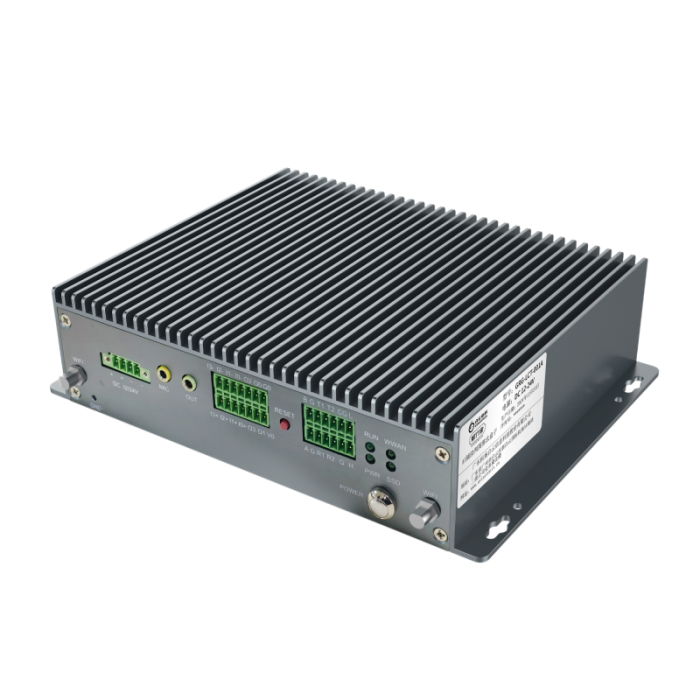
The Edge Computing Unit (MEC) is an edge computing device specifically designed for smart traffic applications. Deployed at intersections or along roadways, it processes perception data collected from radar-vision sensors, cameras, radar sensors, and other front-end devices locally, delivering real-time analysis, sensor fusion, and collaborative decision-making capabilities.
By bringing computing power to the roadside, the MEC significantly reduces data transmission latency, offloads cloud workloads, and supports millisecond-level response for applications such as signal optimization, vehicle-to-everything (V2X) communication, and incident detection. It serves as the core hub for the Perception - Decision - Execution closed-loop system.
Key Advantages
|
Advantage |
Description |
|
Flexible Computing Power |
Scalable up to 200 TOPS; flexible configuration to meet varying application needs—from simple intersections to complex interchanges |
|
Built-In Core Algorithms |
Pre-loaded with traffic-specific algorithms including video cross-fusion, green wave coordination, and single-point adaptive control, significantly shortening deployment time |
|
Open Architecture |
Designed with open standards for seamless integration with diverse systems and third-party algorithms |
|
Rich Interfaces & Scalability |
Equipped with USB, HDMI, Ethernet, RS485, and optional 4G/5G modules, ensuring broad compatibility and easy future expansion |
|
Plug-and-Play |
Supports quick integration with radar-vision sensors, signal controllers, enforcement cameras, RSUs, and other roadside devices with simple on-site configuration |
Product Positioning
The MEC serves as the roadside computing hub in smart traffic systems. It can be deployed independently or integrated with signal controller cabinets:
|
Application |
Description |
|
Signal Controller Computing Supplement |
Provides edge optimization algorithms for signal controllers, enabling single-point adaptive control, green wave coordination, bus priority, and other advanced functions |
|
Radar-Vision Fusion Processing |
Processes radar and video data locally from radar-vision sensors, outputting lane-level traffic volume, queue length, vehicle trajectory, incidents, and other metrics |
|
Enforcement Camera Computing Supplement |
Delivers AI analysis capabilities for enforcement cameras, supporting violation recognition, vehicle feature extraction, and trajectory tracking |
|
V2X Hub |
Fuses roadside perception data and interacts with onboard units (OBUs) via RSUs to enable applications such as green wave guidance and priority passage |
Technical Specifications
|
Parameter |
Specification |
|
Computing Power |
Scalable up to 200 TOPS (configurable) |
|
Core Chip |
High-performance AI processor |
|
Operating System |
Linux-based / open OS |
|
Pre-Loaded Algorithms |
Video cross-fusion, green wave coordination, single-point adaptive control, traffic incident detection, and more |
|
Communication Interfaces |
2*RJ45 ,2*USB, 1*HDMI,1*RS485 |
|
Wireless Expansion |
4G / 5G module (optional) |
|
Operating Temperature |
-40°C ~ +70°C |
|
Protection Rating |
IP65 (outdoor deployment) |
Core Features
Real-Time Perception Fusion
Integrates data from radar-vision sensors, fusing radar and video perception results
Outputs lane-level traffic volume, speed, queue length, vehicle trajectory, and traffic incident metrics
Maintains stable perception in adverse weather conditions including rain, fog, and nighttime
Signal Optimization Computing
Built-in single-point adaptive algorithm dynamically adjusts timing based on real-time traffic demand
Built-in green wave coordination algorithm enables coordinated control across multiple intersections
Supports special control scenarios such as bus priority and emergency vehicle priority
Incident Detection & Alert
Real-time detection of congestion, illegal parking, wrong-way driving, accidents, and other traffic events
Integrates with enforcement cameras to complete violation capture and generate evidence chains
Coordinates with RSUs to push alerts to connected vehicles
Open Integration
Supports connection with multiple signal controller brands via industry-standard protocols
Compatible with third-party detectors and algorithm modules
Provides standard APIs for easy integration with upper-layer platforms
Application Scenarios
|
Scenario |
Application |
|
Single-Point Adaptive Intersection |
Provides real-time optimization algorithms for signal controllers, dynamically adjusting timing based on traffic flow to reduce idle time and congestion |
|
Green Wave Corridor Coordination |
Coordinates signal timing across adjacent intersections to enable green wave progression on arterials, improving throughput |
|
Full-Sensor Intersection |
Fuses radar and video data to create a digital twin of the intersection, providing a data foundation for signal optimization and V2X |
|
V2X (Vehicle-to-Everything) |
Works with RSUs to deliver real-time road condition information and guidance to connected vehicles and autonomous vehicles |
|
Enforcement Camera Upgrade |
Provides AI computing power for enforcement cameras, supporting violation recognition, vehicle tracking, and trajectory analysis |
|
Non-Motorized Vehicle Management |
Identifies violations such as red-light running, wrong-way riding, and helmet non-compliance, supporting enforcement and safety alerts |
Deployment Options
|
Deployment Type |
Description |
|
Standalone Cabinet |
Installed in a dedicated cabinet at new intersections, networked with signal controllers and radar-vision sensors |
|
Integrated with Signal Cabinet |
Co-located within the signal controller cabinet, utilizing existing space to add computing power to existing controllers |
|
Pole-Mounted |
Mounted directly on poles in space-constrained sections, processing perception data locally |
Why Choose Our MEC
Configurable Computing Power:From entry-level to high-performance (up to 200 TOPS), flexible configuration to match intersection complexity and application requirements
Algorithms Pre-Installed: Pre-loaded with proven traffic algorithms, ready for deployment without additional development
Open & Flexible: Supports multiple signal controller brands and detector types; open interfaces facilitate third-party algorithm integration
Comprehensive Scenario Coverage: From signal optimization to V2X, from incident detection to enforcement, a single device covers diverse application needs
Designed for Reliability:Industrial-grade components, wide operating temperature range, and robust protection for continuous roadside operation
Project Cases
Guangzhou Conghua Smart Green Wave Project
MEC deployed in coordination with radar-vision sensors and signal controllers
Single-point adaptive control and green wave coordination implemented
After green wave deployment on Cheng’ao Avenue, average speed increased by over 35%, and average stops per trip reduced by 70%
Maoming Smart City Project
MEC provided real-time optimization algorithm support for signal controllers
Radar-vision sensors achieved vehicle detection accuracy exceeding 95%
Specialized algorithm optimized for non-motorized vehicle waiting zones
Contact Us
The MEC supports flexible customization, including computing power configuration, algorithm functions, and deployment methods tailored to project requirements. Contact us for technical discussions and solution development.

