Traditional fixed-timing traffic lights often fail to adapt to changing traffic conditions, leading to unnecessary delays and increased congestion. Our solution addresses this challenge by combining multi-source sensor data with intelligent algorithms, achieving regional traffic coordination and priority control for special vehicles like ambulances and buses. It not only enhances traffic efficiency but also reduces vehicle emissions and fuel consumption, bringing both economic and environmental benefits to urban traffic management.
Global Urban Traffic Crisis:
Cities worldwide face common and critical pain points in signal control and traffic operation:
Key Urban Traffic Challenges
1.Unscientific Signal TimingTiming relies on manual experience rather than real-time data, leading to wasted green time and low traffic efficiency.
2.Weak All-Weather PerceptionCameras fail in rain, fog, darkness, or glare; traditional detectors lack accuracy and stability.
3.Reactive ManagementProblems are addressed only after congestion or accidents occur, with no real-time warning or proactive control.
4.Isolated Intersection OperationSignals work independently without coordination, making regional green wave and area-wide optimization impossible.
5.Difficult Data IntegrationMultiple systems cannot share data, forming information silos and preventing unified traffic management.
These issues lead to one common outcome: the roads get wider, but the congestion only gets worse.
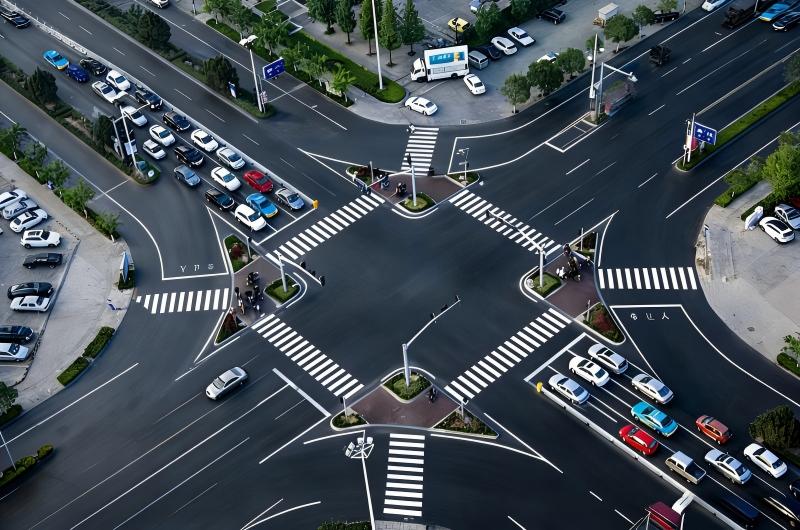
Our Solution: Radar-Vision Fusion + Adaptive Signal Control
We offer a complete smart intersection solution built on a simple core idea:
“Let the intersection see the vehicles. Let the traffic lights learn to think.”
Radar-Vision Integrated Sensors collect real-time, comprehensive traffic data (flow, speed, queue length, trajectory, events, etc.).
MEC (Multi-access Edge Computing) unit analyzes this data in real time and dynamically optimizes the signal controller’s timing plans.
This forms a closed loop:
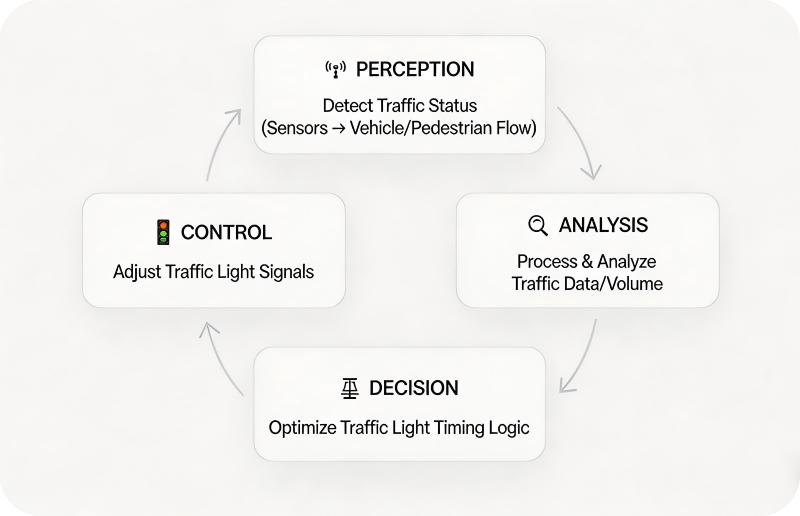
Compared to traditional approaches, our solution delivers three fundamental shifts:
Solution Architecture
We adopt a cloud-edge-device three-layer architecture, ensuring system stability, real-time responsiveness, and flexible scalability.
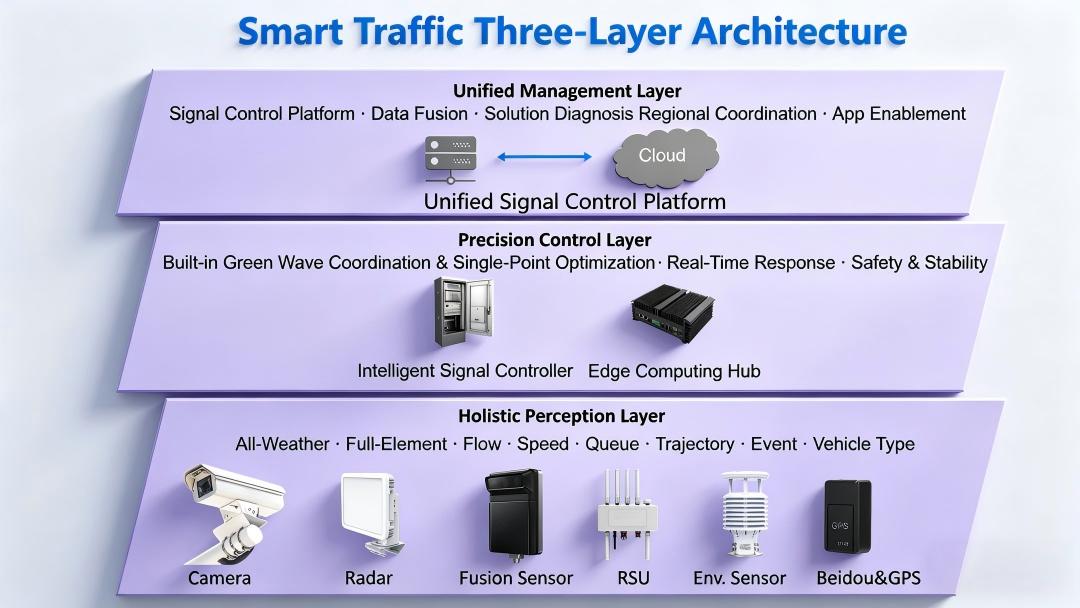
Perception Layer: Radar-Vision Integrated Sensor
Deploy Radar-Vision Integrated Sensors to collect comprehensive intersection traffic data in real time:
Core advantage:
Seamless fusion of radar and video enables all-weather, full-element, high-precision perception. Millimeter-wave radar penetrates rain and fog, and detects accurately even in complete darkness. Video provides rich semantic information, supporting license plate and vehicle type recognition. Together, they achieve an accurate perception.
Control Layer: Signal Controller + MEC
Signal Controller: Executes optimization strategies to close the loop from perception to control. It supports standard protocols for seamless integration with upper-layer platforms and offers open proprietary protocols to run third-party optimization algorithms.
MEC (Multi-access Edge Computing) Unit: Scalable computing power up to 200 TOPS, pre-loaded with mature algorithms for video cross-fusion, green wave coordination, and single-point optimization, significantly shortening deployment time.
Core advantage:
The control layer combines the high stability and security of the signal controller with the low latency and high computing power of MEC to realize local intelligent decision-making and stable and reliable execution, which is the core guarantee for the system to change from fixed timing to adaptive timing and from single-point control to regional coordination.
Management Layer: Signal Control Platform
Unified management of the traffic system and seamless integration with surrounding systems. Key functions include:
Why Choose EnerTraffic?
Radar-vision fusion enables true all-weather, full-element, high-precision perception.
Core products (Radar-Vision Sensor, Speed Radar, Lighting Control Radar) are independently developed, ensuring supply chain control.
A leading Chinese signal controller manufacturer ensures complete and reliable solutions.
Field-tested and validated in multiple cities with real-world performance data.
Flexible configurations tailored to different scenarios and requirements.
Typical Traffic Signal Optimization Illustration
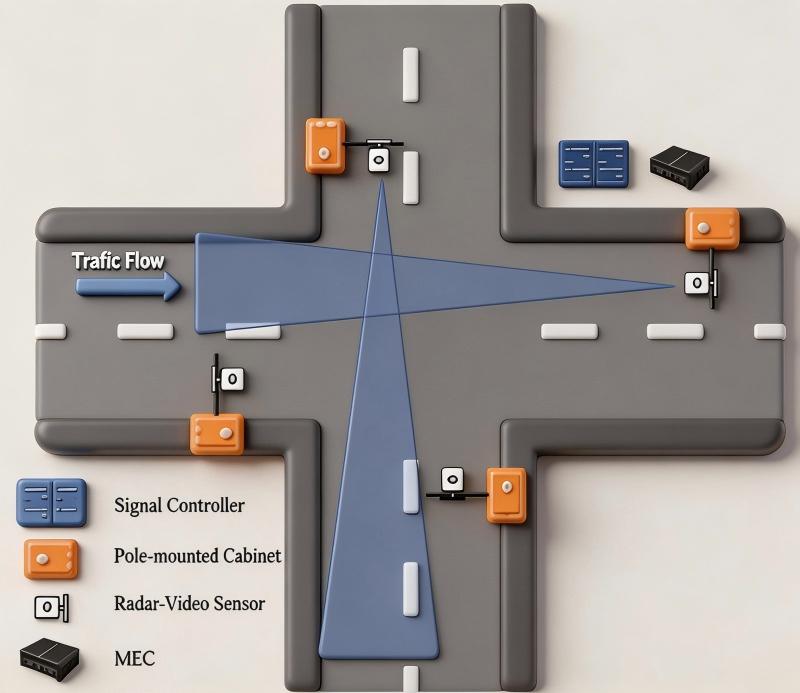
Traffic Signal Optimization Cases
Case1:Conghua Smart Green Wave Project
Project Background
The project targeted pain points including large intersection spacing, mixed traffic flow, mixed motor & non-motor traffic, inconsistent signal controller brands, and unreasonable phase sequences, optimizing 48 arterial intersections with unified signal control and green wave coordination.
Solutions
Results
Case2:Maoming Smart Traffic Project
Project Background
Based on integrated urban traffic big data, the project built an intersection-level intelligent perception and adaptive signal control system, with tailored optimization for non-motor vehicle scenarios.
Solutions
Results
Contact Us
Our Smart Enforcement Solution supports scenario-specific customization and algorithm adaptation. Contact us for technical discussions and solution development.

